Walk into almost any manufacturing business, and you'll hear similar conversations.
Production needs materials sooner. Purchasing is waiting for supplier updates. Sales has promised delivery dates that production hasn't seen. Warehouse teams are trying to locate stock the system says is already available.
Table of Contents
- Manufacturing Doesn't Become Difficult Overnight
- Growth Has a Habit of Creating New Manufacturing Challenges
- Spreadsheets Eventually Reach Their Limit
- Production Planning Is Only One Part of the Story
- Inventory Problems Usually Start Somewhere Else
- The Difference Usually Shows Up on the Busiest Days
- Better Decisions Normally Start with Better Visibility
- Repetitive Work Has a Habit of Taking Over
- The Problem Isn't a Lack of Software
- Knowing When It's Time to Change
- Final Thoughts
- Some FAQs
None of these problems appear overnight. They build gradually as the business grows. What worked with one production line, a handful of suppliers, and fewer customer orders becomes much harder to manage once operations expand.
Many manufacturers respond by adding more spreadsheets, more reports, or another planning tool. That often works for a while. Before long, teams spend more time checking information than acting on it.
Business Central for Manufacturing takes a different approach. Instead of treating production, inventory, purchasing, warehousing, and finance as separate functions, it brings them together through a single manufacturing ERP software platform.
In this article, we'll look at some of the most common manufacturing challenges, why they become harder as businesses grow, and how Microsoft Dynamics 365 Business Central helps manufacturers respond more effectively.
Manufacturing Doesn't Become Difficult Overnight
Manufacturing rarely becomes difficult because of one major event. The changes build gradually as production grows, suppliers increase, and customer demand becomes more complex.
Processes that once felt straightforward begin taking more time to manage. Production is waiting for materials. Purchasing hasn't seen the latest demand. Warehouse teams are working from different stock figures, while management is reviewing reports that no longer reflect what's happening on the shop floor.
Adding another spreadsheet rarely fixes those issues. Problems usually start when different departments rely on different information to make everyday decisions.
Growth Has a Habit of Creating New Manufacturing Challenges
Growth is something every manufacturer works towards. It also changes the way the business operates.
A second warehouse, more suppliers, additional product lines, or higher order volumes all increase the amount of information teams need to manage. Before long, production, purchasing, inventory, and warehousing are influencing one another throughout the day.
It's often at this point that manufacturers begin looking beyond individual software tools. They need manufacturing ERP software that connects operations instead of managing each department separately.
Spreadsheets Eventually Reach Their Limit
Spreadsheets have supported manufacturers for years, and many businesses still depend on them every day. They're used for production schedules, supplier updates, capacity planning, and material shortages.
Problems start when different teams begin updating different versions of the same information. Production changes the schedule. Purchasing is still using yesterday's figures. Warehouse teams haven't seen the latest production order.
Most spreadsheets work perfectly well. The real issue begins when nobody is completely sure which version reflects what's actually happening. That's often where inventory management for manufacturers becomes much harder than it needs to be.
Production Planning Is Only One Part of the Story
Many manufacturers assume better production planning software will solve most operational challenges.
Planning certainly improves, but it doesn't operate on its own.
Every schedule depends on material availability, accurate Bills of Materials (BOMs), reliable routings, supplier performance, and warehouse operations. Change one part of that process and the production schedule changes with it.
Business Central production planning works alongside Material Requirements Planning (MRP), Inventory Management, Warehouse Management, and Supply Chain Management, giving planners a much clearer view of what's happening across the business.
Production delays rarely begin on the shop floor. More often, they start somewhere else and only become visible once production is already affected.
Inventory Problems Usually Start Somewhere Else
When inventory issues appear, stock is usually blamed first.
The decisions behind those shortages often happened much earlier.
Customer demand changes, but purchasing hasn't adjusted future orders. Production priorities shift while warehouse teams continue working from the previous schedule. Supplier lead times increase, yet procurement plans remain unchanged.
A stock shortage rarely appears without warning. By the time production notices it, purchasing may already have been trying to solve the problem for hours.
Business Central for Manufacturing connects purchasing, inventory, production, and warehousing, helping every team work from the same operational information before those issues reach the shop floor.
The Difference Usually Shows Up on the Busiest Days
Production plans rarely fall apart because of one major issue.
It's usually several smaller changes happening at the same time. A supplier delivery arrives late. Sales moves an order forward. A customer changes the quantity after production has already been scheduled. None of those situations is unusual on its own.
Now imagine it's Wednesday afternoon. Purchasing has already been chasing a delayed shipment for hours, but production is still working from the original schedule. Warehouse teams only discover the shortage when materials are needed on the shop floor.
That situation is far more common than many manufacturers expect.
With Microsoft Dynamics 365 Business Central, purchasing, inventory, production, and finance all work from the same operational data. Teams see changes much earlier, giving them more time to adjust before production is affected.
Better Decisions Normally Start with Better Visibility
Many manufacturers expect a new ERP system to transform production overnight.
Most teams notice something much simpler first.
Information becomes easier to trust. Production planners can see whether materials are available before releasing work. Purchasing has a clearer view of future demand, while managers no longer need several reports to understand what's happening across the business.
Using Power BI, they can monitor production performance, inventory levels, and operational trends from connected data instead of piecing information together manually.
The improvement isn't dramatic on day one. It becomes obvious after a few months when fewer decisions depend on guesswork or outdated reports.
Repetitive Work Has a Habit of Taking Over
Ask production planners where time disappears, and the answer is rarely "planning."
It's updating records, checking inventory, chasing approvals, and making the same changes in several places.
None of those jobs is particularly difficult on their own. Together, they gradually take attention away from production.
Manufacturing process automation helps reduce that workload. Production Orders, inventory updates, purchasing recommendations, and approval workflows can move through the system automatically. Microsoft Copilot and the Microsoft Power Platform support many of those everyday activities, allowing teams to spend less time on repetitive administration.
People still make the decisions. They simply spend less time preparing the information needed to make them.
The Problem Isn't a Lack of Software
Most manufacturers already have software for something.
Production planning might sit in one application. Inventory lives somewhere else. Purchasing has its own process, while warehouse teams rely on another tool altogether.
Individually, those systems may work perfectly well.
Problems usually begin once information has to move between them. One purchasing update can affect production later that day. A stock adjustment made in the warehouse may not reach the planner until much later.
Business Central for Manufacturing connects those activities through a single platform. Material Requirements Planning (MRP), Supply Chain Management, Warehouse Management, Inventory Management, Production Orders, BOMs, and Routings all contribute to the same operational picture.
By the end of the week, teams shouldn't be comparing different reports to understand what happened. They should already be working from the same information.
Knowing When It's Time to Change
Manufacturers don't all reach the same point at the same time.
For some, production planning becomes harder to manage. Others start seeing inventory issues affect customer deliveries. In many businesses, spreadsheets, emails, and disconnected systems simply take more effort to manage than they used to.
Take a supplier delaying a delivery on Tuesday morning. Production has already planned work for Wednesday, but purchasing doesn't see the update until later in the day. Warehouse teams end up moving stock around just to keep production going.
That doesn't automatically mean the software is the problem. More often, different teams are working from different information.
Many manufacturers begin looking at Microsoft Dynamics 365 Business Central for that reason. It brings purchasing, production, inventory, and warehousing together, making it easier for everyone to work from the same information.
Final Thoughts
Manufacturing rarely follows the original plan for long.
Customer demand changes. Suppliers run late. Production schedules move throughout the week. That's simply part of running a manufacturing business.
The businesses that respond well usually see those changes early.
By the time production hears about a supplier delay, purchasing may already have spent hours trying to solve it. Shared information helps everyone respond at the same time instead of reacting one department after another.
If you're reviewing your current manufacturing ERP software, start with the everyday problems rather than the feature list. Understanding where information slows down often tells you more than another software demonstration.
At Dynamics Square, we help manufacturers implement Microsoft Dynamics 365 Business Central to improve production planning, strengthen inventory visibility, and help teams work from the same operational information. Connect with us Today!
Some FAQs
What are the biggest manufacturing challenges?
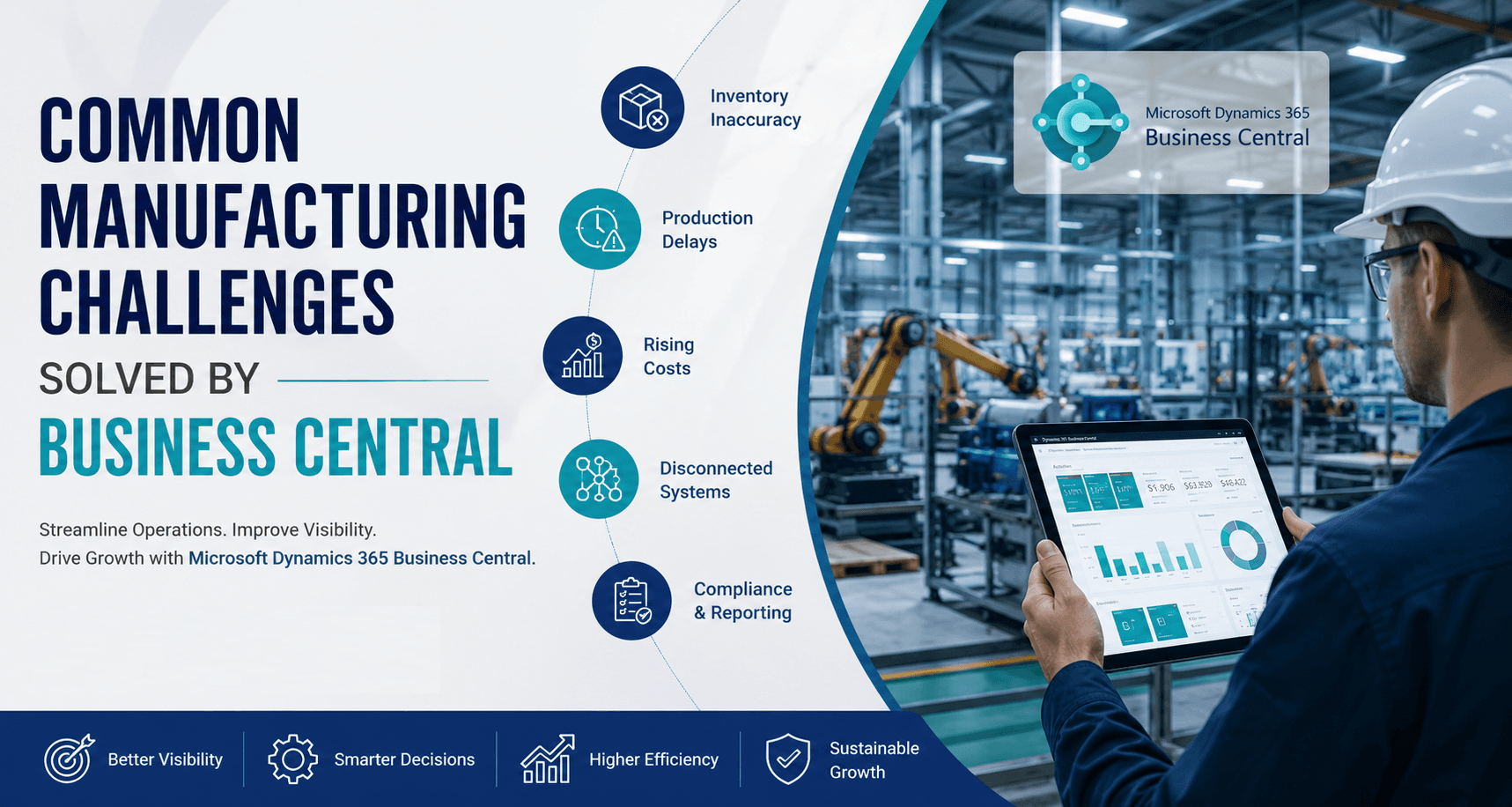
Common manufacturing challenges include production planning, inventory accuracy, supply chain disruptions, rising costs, and keeping different departments aligned.
How does Business Central help manufacturers?
Business Central for Manufacturing connects production, inventory, purchasing, warehousing, and finance, giving teams a single view of operations.
Can Business Central improve production planning?
Yes. Business Central production planning works with Material Requirements Planning (MRP), inventory, and production orders to support more accurate scheduling.
How does Business Central reduce inventory issues?
By connecting inventory, purchasing, production, and warehouse operations, Business Central helps manufacturers identify shortages and improve stock accuracy.
Is Business Central good for manufacturing companies?
Yes. It's well suited to manufacturers that need better production planning, inventory control, and operational visibility as they grow.
What manufacturing problems does Business Central solve?
It helps address production planning, inventory management, shop floor management, supply chain visibility, warehouse operations, and manufacturing process automation.
Why do manufacturers choose Business Central?
Manufacturers choose Microsoft Dynamics 365 Business Central because it connects business operations, improves visibility, and supports future growth.
How does Business Central improve supply chain visibility?
It gives purchasing, production, inventory, and warehouse teams access to the same real-time information, making it easier to respond to changes.
Can Business Central automate manufacturing operations?
Yes. Business Central automates routine tasks such as production orders, approvals, purchasing workflows, and inventory updates. Microsoft Copilot and the Microsoft Power Platform extend these capabilities further.
What are the benefits of Business Central for manufacturers?
Key benefits include better production planning, improved inventory management, stronger supply chain visibility, reduced manual work, and more informed decision-making.