The ERP capabilities have improved quite a bit over the last few years. If you search for an ERP system, you will find many options, and you may compare Business Central vs Sage 200, but as we know, all ERP systems are not similar, and they offer different features and functionalities.
Most businesses already have systems for financing, inventory, purchasing, and reporting. The current challenge is that expectations from an ERP system have changed over time. Organisations now want more from ERP, which mainly includes better integration between systems, easy access to information and more automated everyday tasks.
Table of Contents
- Business Central vs Sage 200: A Quick Summary
- Business Central vs Sage 200 at a Glance
- What Is Sage 200?
- What is Microsoft Dynamics 365 Business Central?
- Why Are Businesses Comparing Sage 200 and Business Central?
- Business Central vs Sage 200: The Key Differences
- Business Central Features vs Sage 200 Features
- Reporting and Business Intelligence
- Integrations
- Business Central AI and Copilot vs Sage 200
- Business Central Pricing UK vs Sage 200
- Why Businesses Migrate from Sage 200 to Business Central
- Business Central Implementation UK: Things to Consider
- Which ERP Is Better for UK Businesses?
- Choose Sage 200:
- Choose Business Central:
- Final Thoughts
- Some FAQs
That's why more organisations are comparing powerful ERP systems, like Sage 200 and Microsoft Dynamics 365 Business Central.
As we know, both of them are well-established ERP solutions in the UK market but evolved differently over time.
Sage 200 continues to be a trusted choice for businesses that prefer established processes and deployment flexibility. Business Central has become more cloud, more automated, and more part of the Microsoft technology ecosystem.
For many businesses, it’s not so much a question of features, but rather which platform is a better fit for the next stage of growth.
In this article, we’re going to take a deep dive into Business Central vs Sage 200 and look at the factors that can help you decide which is the best fit for your organisation.
Business Central vs Sage 200: A Quick Summary
If you're short on time, here's the simple answer:
✅ Choose Microsoft Dynamics 365 Business Central if you:
- Want a cloud-first ERP platform
- Already use Microsoft 365, Teams, or Power BI
- Need stronger automation and AI capabilities
- Expect your business to grow or become more complex
- Want regular Microsoft updates and continuous innovation
✅ Choose Sage 200 if you:
- Already have a significant investment in Sage products
- Prefer on-premise or hybrid deployment options
- Have relatively stable business processes
- Need a familiar accounting environment without major operational change
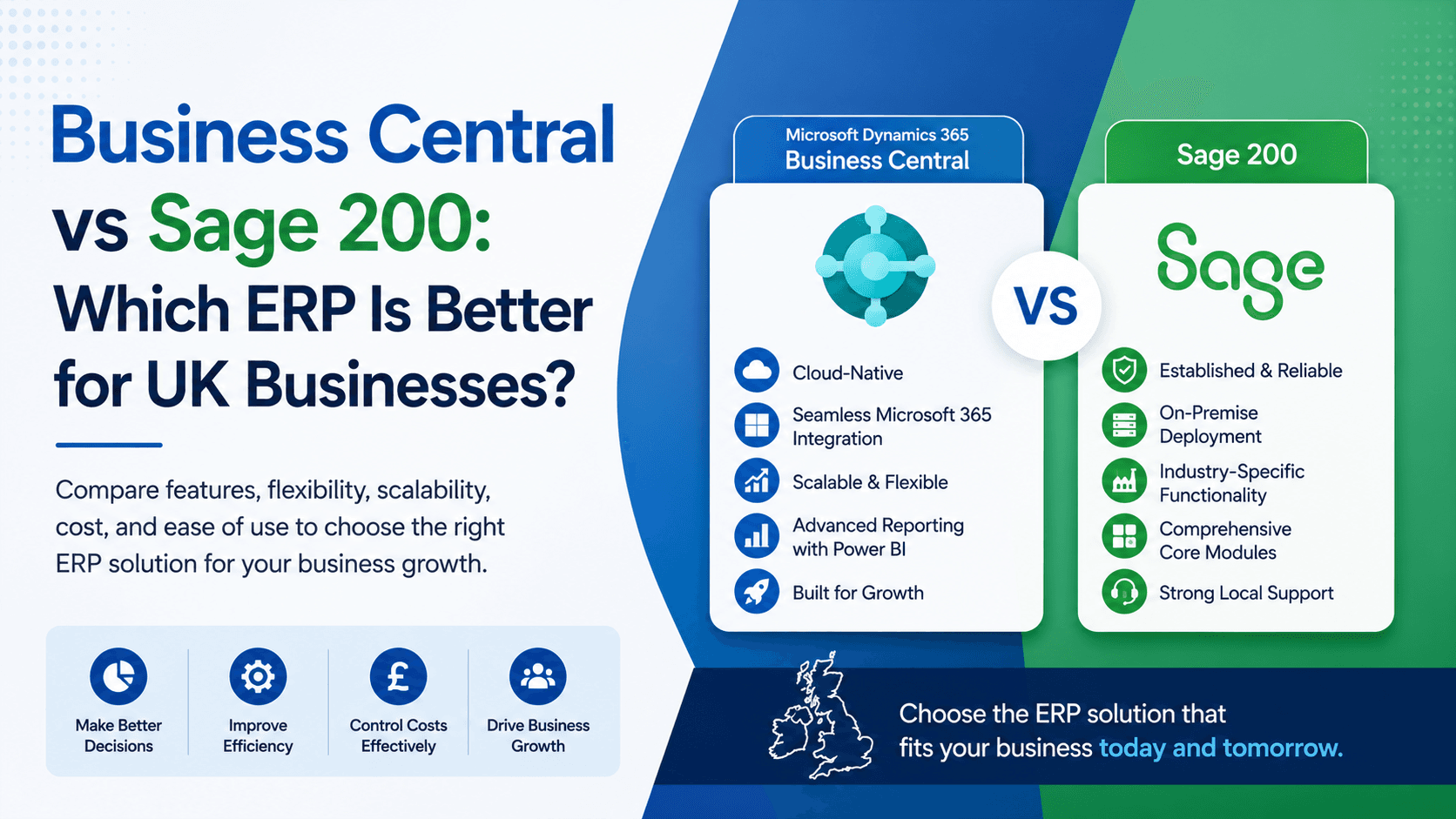
The decision usually comes down to future plans. Sage 200 works well for businesses that want continuity, while Business Central often appeals to those looking forward to cloud, automation, and long-term growth.
Business Central vs Sage 200 at a Glance
| Area | Business Central | Sage 200 |
|---|---|---|
| Deployment | Cloud-first SaaS ERP | On-premise, hosted, and cloud-connected |
| Best For | Growing businesses and digital transformation | Businesses with established Sage processes |
| Financial Management | ✔ | ✔ |
| Reporting | Power BI and real-time dashboards | Built-in and third-party reporting |
| AI Capabilities | Copilot and AI Agents | Limited |
| Integrations | Deep Microsoft ecosystem | Good third-party integrations |
| Scalability | High | Moderate to High |
| Cloud Strategy | Strong Microsoft investment | Evolving cloud strategy |
What Is Sage 200?
Sage 200 is a popular ERP system that has been used by many small and mid-sized businesses in the UK for years.
Key areas covered by Sage 200 include finance, purchasing, inventory, sales order processing and reporting. It supports a number of setup environments. It can be deployed on-premise, in a hosted environment or in a hybrid setup.
What is Microsoft Dynamics 365 Business Central?
Microsoft Dynamics 365 Business Central is a cloud based ERP system. It is designed specifically for small and medium-sized businesses.
It connects everything in one place, whether it is finance, sales, purchasing, inventory, projects, or day-to-day operations. Business Central can integrate seamlessly with other Microsoft apps like Microsoft 365, Teams, Power BI and Power Platform.
Why Are Businesses Comparing Sage 200 and Business Central?
Many businesses do not start looking for a new ERP system because they want one.
The conversation usually begins when existing processes become harder to manage.
- Reports take longer to prepare.
- Spreadsheets become more common.
- Information sits in different systems.
- Introducing new processes requires increasing amounts of manual work.
At some point, businesses start asking whether their current ERP platform can support where the organisation is heading next.
That is often when the Sage 200 vs Dynamics 365 Business Central discussion begins.
Business Central vs Sage 200: The Key Differences
Let's look at the key differences between Business Central vs Sage 200:
Cloud Strategy
This is one of the biggest differences between the two platforms.
Sage 200 supports on-premise, hosted, and hybrid deployments.
Business Central follows a cloud-first approach and receives regular Microsoft updates, new capabilities, and continued investment in AI and automation.
For organisations planning long-term digital transformation initiatives, this difference often becomes an important factor.
User Experience
Both products cover many of the same business functions, but when it comes to user experience, it is quite different.
Businesses that have used Sage products for years often appreciate the Sage 200 familiarity.
Business Central benefits from its close connection with Outlook, Excel, Teams, and other Microsoft applications.
For organisations already using Microsoft technologies, that familiarity can make adoption easier.
Scalability
When your business grows, it changes your ERP requirements.
More customers means more products, and more reporting requirements that place additional pressure on existing systems.
Both platforms, Sage 200 and Business Central, can support growing businesses.
The difference often comes down to how far organisations expect their ERP system to evolve alongside automation, analytics, and wider digital initiatives.
Business Central Features vs Sage 200 Features
Financial Management
Finance is rarely the deciding factor in this comparison.
Both systems cover the core accounting requirements that most SMEs expect from an ERP solution.
Capabilities available in both products include:
- General ledger
- Accounts payable
- Accounts receivable
- Budgeting
- Bank reconciliation
- Financial reporting
Most businesses comparing the two are usually looking beyond core accounting and asking broader questions around reporting, integrations, and future scalability. Read more for Financial Management.
Inventory and Supply Chain Management
Inventory requirements vary considerably from one organisation to another.
For some businesses, stock control is enough.
Others need forecasting, warehouse management, supplier management, and deeper visibility across operations.
Both products offer inventory capabilities, although organisations with broader automation and reporting requirements often look more closely at Business Central. Read more for Supply Chain Management.
Reporting and Business Intelligence
Reporting expectations have changed significantly over the last few years.
Businesses increasingly want information in real time rather than waiting for scheduled reports.
Business Central Reporting
- Power BI integration
- Interactive dashboards
- Self-service analytics
- Real-time reporting
Sage 200 Reporting
- Financial reporting
- Operational reports
- Third-party reporting tools
- Custom reporting capabilities
For many organisations, reporting becomes one of the most important parts of the ERP decision.
Integrations
Most businesses use more than one system.
CRM applications, ecommerce platforms, reporting tools, and third-party solutions all play a role.
Business Central Integrations
- Microsoft 365
- Teams
- Power BI
- Power Automate
- Power Apps
- Dynamics 365 applications
- Azure services
Sage 200 Integrations
- CRM systems
- Ecommerce platforms
- Document management solutions
- Industry-specific applications
- Third-party connectors
The importance of integrations often depends on how heavily the organisation already relies on Microsoft technologies.
Business Central AI and Copilot vs Sage 200
One of the biggest differences between the two platforms today is the direction Microsoft and Sage are taking with AI.
Microsoft has invested heavily in AI capabilities across Dynamics 365, Microsoft 365, Power Platform, and Azure. Those investments are increasingly finding their way into Business Central through Copilot and AI-powered experiences. Check Now - AI Agents in Business Central.
Sage is also investing in AI, but the depth and maturity of capabilities currently differ.
| Capability | Business Central | Sage 200 |
|---|---|---|
| Generative AI | ✔ Copilot | Limited |
| AI Agents | ✔ | No native capability |
| Natural Language Queries | ✔ | Limited |
| Content Generation | ✔ | No |
| Process Automation | Power Platform + AI | Workflow automation |
| Microsoft's AI Investment | High | Moderate |
For businesses looking beyond traditional ERP functionality, AI capabilities are becoming a much bigger part of the evaluation process.
Business Central Pricing UK vs Sage 200
Pricing is often one of the first questions businesses ask, but software licences are only part of the picture.
Implementation, customisations, integrations, support requirements, and long-term maintenance can all influence the overall investment.
Business Central Pricing UK
Microsoft currently offers three licensing options.
Essentials
From approximately £61.50 per user/month
Suitable for businesses requiring:
- Finance
- Sales
- Purchasing
- Inventory
- Projects
- Reporting
Premium
From approximately £84.60 per user/month
Includes everything in Essentials plus:
- Manufacturing
- Service management
Team Members
Approximately £6.60 per user/month
Designed for users requiring limited access, approvals, and updates. View more about Business Central Pricing.
Sage 200 Pricing
Sage 200 pricing varies depending on the edition, number of users, and additional modules.
Sage 200 Standard
It can cost approximately £390–£400+ per month
Suitable for businesses requiring:
- Finance
- Sales and purchasing
- Inventory management
- Reporting
Sage 200 Professional
It can cost approximately £370–£380+ per month (base licence)
Suitable for businesses requiring:
- More advanced reporting
- Additional users and modules
- More complex operational requirements
Additional costs may apply for:
- Extra users
- Manufacturing modules
- Project accounting
- Hosting and support services
As with Business Central, many organisations look beyond licence costs and focus on the overall value, scalability, and long-term fit of the platform.
Why Businesses Migrate from Sage 200 to Business Central
Not every business using Sage 200 is looking to move.
Many organisations continue to run the platform successfully.
However, businesses considering migration often mention similar challenges:
- Growing reporting requirements
- Increasing reliance on spreadsheets
- The need for stronger integrations
- Cloud-first strategies
- Digital transformation initiatives
- Automation and AI requirements
For organisations already using Microsoft technologies, Business Central can feel like a natural next step because it extends capabilities across applications that employees already use every day.
The decision to migrate from Sage 200 to Business Central is rarely driven by one feature. It is usually the result of changing business requirements and future plans.
Business Central Implementation UK: Things to Consider
ERP implementation projects rarely succeed because of technology alone.
The quality of planning often has a much bigger impact on the outcome.
Areas that usually require attention include:
- Data migration
- Reporting requirements
- User adoption
- Integrations
- Business processes
- Training
- Future scalability
This applies whether a business is implementing ERP for the first time or replacing an existing platform.
Working with an experienced Microsoft Dynamics 365 partner UK like Dynamics Square can make the transition significantly easier, particularly for organisations moving from legacy systems.
Which ERP Is Better for UK Businesses?
There is no universal answer because every organisation has different priorities.
However, certain patterns appear repeatedly.
| Business Requirement | Better Fit |
|---|---|
| Existing Sage investment | Sage 200 |
| Cloud-first strategy | Business Central |
| Microsoft ecosystem integration | Business Central |
| AI and automation requirements | Business Central |
| Hybrid deployment requirements | Sage 200 |
| International growth plans | Business Central |
| Advanced analytics | Business Central |
| Familiar accounting environment | Sage 200 |
Choose Sage 200:
- If your requirements are relatively stable.
- If you prefer on-premise or hybrid deployments.
- If your existing Sage investment already meets most operational needs.
Choose Business Central:
- If you are looking for a modern Cloud ERP UK platform.
- If you want stronger Microsoft integration.
- When AI and automation are becoming important priorities.
- If your business is preparing for future growth and digital transformation.
Final Thoughts
There is no straight answer to the Business Central vs Sage 200 question which one is better because every business is starting from a different place and everyone has different requirements.
Some organisations are looking for continuity and want to build on processes that already work well. Others are reviewing how cloud, automation, and AI could support future plans.
Both platforms can support growing businesses.
The decision usually comes down to priorities, existing investments, and where the business expects to be in the next few years.
If you're reviewing Sage alternatives or considering a move to Business Central, taking time to understand the wider business requirements often makes the technology decision much easier. Dynamics Square UK can make it easy by assessing your requirements, recommending the right approach, and providing support for your Business Central implementation UK journey. Connect with us Today!
Some FAQs
Is Business Central better than Sage 200?
It depends on business requirements. Business Central is often preferred for cloud adoption, Microsoft integrations, automation, and AI capabilities, while Sage 200 remains a strong option for businesses with established Sage environments.
Should I choose Sage 200 or Business Central?
The decision depends on your priorities, future growth plans, deployment preferences, and integration requirements.
Which ERP is better for UK businesses?
There is no single answer. Businesses prioritising cloud, automation, and scalability often favour Business Central, while organisations with stable requirements may continue using Sage 200.
What is the difference between Business Central and Sage 200?
The biggest differences are cloud strategy, integrations, AI capabilities, and Microsoft's continued investment in automation and Copilot experiences.
Can I migrate from Sage 200 to Business Central?
Yes. Many organisations choose to migrate from Sage 200 to Business Central as requirements evolve and cloud adoption becomes a priority.
Is Sage 200 cloud based?
Sage 200 supports on-premise, hosted, and cloud-connected deployment models.
Why switch from Sage 200?
Common reasons include stronger integrations, cloud strategies, advanced reporting, automation requirements, and AI capabilities.
Is Business Central worth it?
For many growing businesses, Business Central provides a combination of ERP functionality, Microsoft integration, and long-term scalability that makes it a strong investment.
Which ERP is easier to use?
This often depends on existing experience. Long-time Sage users may prefer Sage 200, while businesses already using Microsoft applications often find Business Central easier to adopt.
Which ERP offers better AI features?
Business Central currently offers broader AI capabilities through Business Central Copilot and Microsoft's growing investment in AI and automation across Dynamics 365.