
500+
Innovative Implementations
150+
Certified Professionals
14+
Years of Experience
What Dynamics 365 ERP for Aerospace and Defence Manufacturing Delivers
Dynamics 365 ERP for aerospace and defence manufacturing connects purchasing, production, inventory, quality checks, and finance in one system. It helps manufacturers trace every component, record material details, track inspections, and manage design changes.
Aerospace suppliers can maintain records for aircraft parts, machined components, and assemblies. Defence manufacturers can also monitor contract costs, delivery schedules, and material availability. This gives teams clear information about each part, from material purchase to final delivery, while supporting customer audits and quality requirements.
Dynamics Square suggests two routes into Dynamics 365 for aerospace and defence manufacturing.

Business Central is meant for precision engineering firms, component suppliers, wiring and cable harness manufacturers, and contract manufacturers handling smaller production runs and repeat orders.

Supply Chain Management is an ideal choice for larger manufacturers with several sites, complex products, or projects that involve frequent design changes. It helps manage changing specifications, production schedules, and project costs across larger operations.
Your business remains responsible for AS9100 certification, customer approvals, and MOD supplier requirements. Dynamics 365 helps maintain the material, inspection, and production records needed to support audits and quality checks.
Find the Right Platform for Your OperationUK Aerospace and Defence Compliance Requirements
Three important areas influence the records and controls that UK aerospace and defence manufacturers must maintain. These requirements cover aviation production, defence supply chain security, and export controls.

Aviation Production Approvals
The UK Civil Aviation Authority (CAA) may require aircraft manufacturers and certain component suppliers to hold Part 21 Subpart G approval. This requires an approved production manual and processes that ensure parts meet approved designs. Many aerospace customers also expect suppliers to follow AS9100 quality standards. Manufacturers must maintain production, inspection, and material records to demonstrate that their processes meet these requirements.

MOD Supply Chain Cyber Requirements
Suppliers working on Ministry of Defence (MOD) contracts may face cybersecurity requirements under DEFCON 658. These depend on the contract's Cyber Risk Profile and the applicable Cyber Security Model requirements. Suppliers may also need to pass relevant requirements to subcontractors. Businesses should consider how contract information is stored, who can access it, and how connected systems handle sensitive data.

UK Strategic Export Controls
UK manufacturers exporting military or controlled dual-use products must follow applicable export control rules. The Export Control Joint Unit manages relevant export licences under the Export Control Order 2008. Manufacturers need accurate records showing which products were shipped, who received them, and which licence covered each shipment. Linking product, customer, and delivery records helps teams demonstrate compliance during checks.
Aerospace and defence programmes can continue for decades, making reliable records essential throughout their lifespan. Manufacturers need systems that preserve accurate production, inspection, material, and export information, even when employees, suppliers, and business processes change over time.
Bills of Materials and Engineering Changes

Multi-level bills of materials show how individual components fit together to make larger assemblies, with separate versions and approval records for each item.

Where-used searches identify every product or assembly containing a component, helping teams understand which orders may be affected by a change.

Engineering change requests and orders follow approval steps, ensuring buyers, production planners, and operators always work from the same approved design.
Traceability and Component History

Dynamics 365 records the history of each material batch and serialised component, starting when materials arrive at the factory and continue through production.

Teams can trace a delivered component back to its original material batch or identify every finished unit made using a questionable batch.

Suspected materials or components can be placed on hold, preventing their use in production until the quality team approves them.
Contract-Based and Custom Manufacturing

Dynamics 365 manages one-off manufacturing projects from design and material purchasing through production, while tracking costs against each project's approved budget.

Contract billing features help manufacturers track customer payments against agreed project stages, delivery milestones, and completed work.

Order-to-order planning links material purchases and production directly to specific customer requirements, keeping contract-specific components separate from general stock.
Suppliers, Planning and Quality

Subcontracting records help manage outside work such as plating, heat treatment, and testing, while tracking materials sent to external suppliers.

Material Requirements Planning considers customer orders, stock levels, and supplier delivery times when suggesting what manufacturers need to purchase or produce.

Inspection results and quality problems can be recorded against specific material batches and production orders, helping teams investigate issues and maintain records.
Business Central or Supply Chain Management for Aerospace and Defence Manufacturing
The right ERP for aerospace and defence manufacturing depends on how you manage engineering changes, customer contracts, production, and quality records. Dynamics Square helps you choose between Business Central and Supply Chain Management based on these requirements.
Choose Business Central if
- You manufacture components and assemblies using customer-approved engineering drawings.
- You handle repeat orders or smaller production runs using approved material lists.
- You need component tracking, detailed material lists, and production control for a mid-sized business.
- Your quality management activities are handled through a separate system alongside your ERP.
Choose Supply Chain Management if
- Designs change during projects and revisions require formal approval before production.
- Customers select product features that affect materials, components, and manufacturing steps.
- You manage project costs by contract and bill customers against agreed milestones.
- Your manufacturing operations span several factories, companies, or currencies.
| Aspects | Business Central | Supply Chain Management |
|---|---|---|
| Manufacturing style | Discrete and repetitive (Premium licence) | Discrete, configured and project-linked |
| BOM control | Multi-level production BOMs with versions | Product versioning with change requests and orders |
| Lot and serial tracking | Item tracking and Item Tracing | Batch and serial tracking across production |
| Engineer-to-order | Order-linked planning, job accounting alongside | Projects with work breakdown structures on production orders |
| Quality | Native inspections and lot blocking | Quality orders, nonconformance and sampling |
| Multi-entity scale | Several companies and locations, with simpler consolidation | Multiple entities, sites and currencies at larger scale |
| Starting licence (UK) | Premium: £84.60/user/month | Standard: £161.50/user/month |
Many aerospace and defence manufacturers use separate software to manage engineering designs and quality checks, including AS9102 First Article Inspection. Dynamics 365 manages related material, production, and cost records. During discovery, Dynamics Square identifies which systems need connecting and how information should move between them.
Get a Platform Recommendation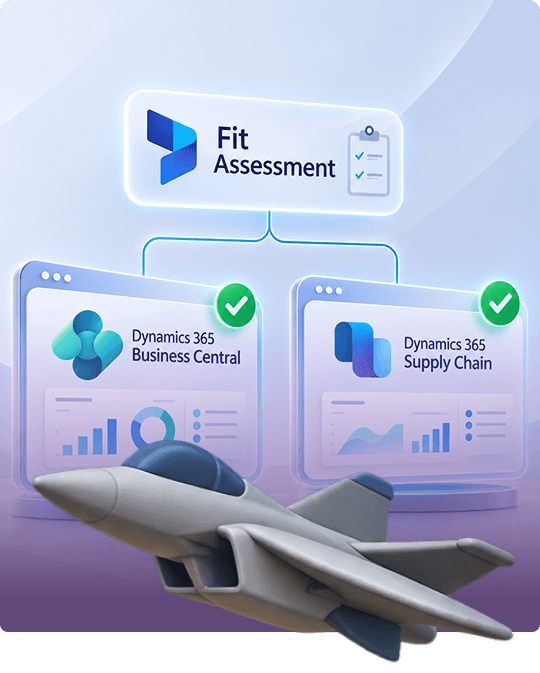
What Is the Best ERP for Aerospace and Defence Manufacturing?
Choosing the best ERP for aerospace and defence manufacturing starts with how your programmes are designed, scheduled and invoiced. A precision machining firm and a business engineering to order will reach different answers, and each answer can be right.
Every aerospace and defence enquiry at Dynamics Square starts with a fit assessment, covering BOM depth, change control, contract structure, site count and the systems that need to connect, before we name a platform.
Book Your Free Fit AssessmentHow Dynamics Square Runs Dynamics 365 Implementation for Aerospace Manufacturers
Dynamics Square follows Microsoft's Success by Design approach when implementing Dynamics 365 for aerospace manufacturers. We focus early on product structures, component tracking, and data transfer because these form the foundation of reliable production records. For UK defence projects, we also agree where sensitive MOD information and engineering designs will be stored.
Discover
Dynamics Square reviews your product designs, material lists, tracking requirements, and special manufacturing processes. We also identify which existing systems need connecting to the ERP.
Initiate
At this stage, Dynamics Square agrees on the project scope, ERP product, data storage arrangements, and responsibilities with your management team before implementation begins.
Implement
Next, Dynamics Square configures the system, transfers product, material, and batch records, and connects engineering, quality, and factory software where required.
Prepare
Dynamics Square helps your employees test the system using actual parts and customer orders. We also train your teams before the new system goes live.
Operate
In the end, Dynamics Square continues supporting your business after launch, helping manage customer audits, engineering changes, and new manufacturing programmes.
Dynamics 365 Pricing for Aerospace and Defence Manufacturers in the UK
The prices below are current UK list prices in pounds sterling, excluding VAT. Your final cost depends on the number of full and occasional users and any integrations needed with your design, quality, and factory systems.
Dynamics 365 Business Central
It covers financial management, sales, purchasing and inventory.
Production orders, BOMs, routings and MRP, plus Quality Management inspections on production output.
It offers read, approve and light self-service access.
Dynamics 365 Supply Chain Management
Engineering change, configured products, project-linked production and quality orders, with limited demand planning
Everything in Standard, together with full demand planning, capacity and storage planning, and Copilot Credits
ERP implementation is a separate cost from software licences. The price depends on your factory locations, product complexity, custom manufacturing needs, and the amount of existing data to transfer. Dynamics Square reviews these requirements and prepares a quotation based on your project scope.
Get a Custom Quote
Why UK Aerospace and Defence Manufacturers Work with Us
Dynamics Square has completed 60+ manufacturing ERP implementations, bringing practical experience in production planning, material tracking, component traceability, and quality management.
Our team of 35+ manufacturing and supply chain consultants understands the challenges of managing complex production processes, engineering changes, and customer requirements.
We study your traceability needs, engineering processes, and contract requirements before recommending Business Central or Supply Chain Management. Our recommendation focuses on what works best for your operations.
Our consultants hold Microsoft certifications across both ERP products. This helps us provide balanced advice and configure the system around your manufacturing requirements.
Our support continues after implementation, helping your team manage engineering changes, new programmes, customer audits, and changing production requirements.
We help maintain clear production, inspection, and material records so your business can respond to customer checks and delivery requirements with confidence.
Speak to an Aerospace ERP SpecialistYes, Dynamics 365 helps aerospace and defence manufacturers manage product structures, component tracking, production costs, and delivery schedules. Business Central suits manufacturers producing parts to approved drawings and repeat orders. Supply Chain Management supports larger businesses with complex designs, frequent engineering changes, and multiple factories. Design and specialist quality software can connect with either system.
Yes, Dynamics 365 manages multi-level bills of materials, showing how individual components and smaller assemblies fit into a finished product. Business Central supports approved BOM versions and component searches. Supply Chain Management adds engineering change management to control design revisions and approvals. Manufacturers can also connect their PLM system to transfer approved engineering information into the ERP.
Yes, Dynamics 365 tracks material batches and serialised components from goods receipt through production and final delivery. Teams can trace a delivered part back to its original material batch or identify customers who received products made from a particular batch. Material certificates and inspection records can also be linked through the appropriate configuration.
Yes, Supply Chain Management supports engineer-to-order manufacturing by linking production activities with projects, budgets, work breakdown structures, and milestone billing. Business Central can also manage smaller custom orders through order-based production planning and job costing. The right option depends on your project complexity, engineering changes, and contract requirements.
Yes, Business Central supports quality inspections and can block materials that fail checks. Supply Chain Management offers additional tools, including quality orders, sampling plans, and nonconformance records. Aerospace manufacturers following AS9100 may use separate quality software for AS9102 First Article Inspection. Your organisation remains responsible for approvals and compliance, while Dynamics 365 helps maintain supporting production and inspection records.