
500+
Innovative Implementations
150+
Certified Professionals
14+
Years of Experience
Dynamics 365 ERP for Food and Beverage Manufacturing, Explained
Dynamics 365 ERP for food and beverage manufacturing configures Microsoft's cloud ERP for firms that make, blend, bake, brew or bottle goods for sale. Purchasing, goods-in, recipes, production orders, date marks, quality checks, warehousing and accounts share one set of records. When a supplier flags a faulty delivery, the system lists the production runs that drew on it and the customers who received what those runs made.
Dynamics Square proposes two products here, each suited to a different kind of producer.

It suits bakeries, specialist food producers, craft brewers and distillers, soft drinks makers and co-packers who work from an established recipe set across one or a few sites. The modules that matter most are production orders with bills of materials, lot numbers with expiry dates, warehouse picking by earliest expiry and the Quality Management module introduced with the 2026 release wave.

It suits dairy, meat and fish processors, ingredient and flavour makers and larger drinks groups. Formulas there vary with raw material quality, runs give off co-products, goods are sold by weight, or output comes from several sites. Its main modules are formula management, batch attributes, shelf-life dating, catch weight handling and quality orders.
Food safety compliance depends on your HACCP plan, trained staff, and accurate records. Dynamics 365 helps maintain the lot history, date controls, and quality records that support these programmes. The sections below explain how each feature supports your food safety processes.
Find the Right Platform for Your OperationUK Food Law: Required Records and Compliance
Four areas of UK food law and industry practice shape how a food manufacturer's systems need to behave.

Traceability under general food law
Article 18 of assimilated Regulation (EC) 178/2002 requires every food business to trace what it receives from suppliers and what it supplies to other businesses, one step back and one step forward. Records cover names and addresses, the product, quantity and transaction dates. The Food Standards Agency (FSA) guidance suggests keeping them, as a minimum, for the shelf life of a prepacked product plus 12 months.

Withdrawal and recall duties
Under Article 19, a business that has reason to believe food is unsafe must start withdrawing it immediately and tell its enforcement authority, as well as the FSA or Food Standards Scotland. Suppliers and business customers affected by the incident also need to be informed. A recall record that already links lots to customers turns that notification into a short report.

Allergens and date marks
Fourteen allergens are controlled in UK law: celery, cereals containing gluten, crustaceans, eggs, fish, lupin, milk, molluscs, mustard, peanuts, sesame, soya, sulphur dioxide and sulphites, and tree nuts. On prepacked food they must be emphasised within the ingredients list. Since 1 October 2021, food packed on the premises where it is sold, such as a bakery's shop-counter products, must also carry a full ingredients list. A "use by" date marks a food safety limit, whereas "best before" describes quality, and an ERP that stores both dates separately keeps stock decisions accurate.

HACCP records and customer audits
Food businesses must keep procedures based on HACCP principles and the records that prove them. Retail customers and audit schemes such as BRCGS commonly expect regular mock recall tests, in which a lot is traced end to end against the clock.
Traceability and batch genealogy

Lot numbers issued to every ingredient, intermediate, pack component and finished product on arrival or manufacture

Production orders that log the ingredient lots they use and open a new lot for the product they make, which is the basis of food batch manufacturing software

Item tracing in both directions, so one supplier lot reveals every finished lot it entered, and one customer complaint reveals every ingredient lot behind the pack

In Supply Chain Management, the trace extends to the customers and shipped sales orders affected, which is the working core of food traceability software
Date marks and shelf-life control

Expiry dates captured at goods-in or at production, with strict expiration posting available to keep expired lots out of picks

Picking by earliest expiry date, switched on per warehouse location in Business Central

In Supply Chain Management, shelf advice, best-before and expiry periods set per product, so the three dates follow the product's own rules

Sellable days per customer, which stops short-dated lots going to a customer who needs a minimum remaining life on delivery
Recipes, formulas and allergen data

Business Central production bills of materials, where each version has its own start date and certification status, so a reformulation goes live on an agreed day

Supply Chain Management formulas that are approved and activated before use, with quantities driven by batch size or by the percentage of each ingredient, and ingredients drawn down in stages. This is recipe and formula management software built for plants that adapt to raw material variation.

Co-products and by-products booked into stock from the same run, such as whey from cheesemaking or spent grain from brewing

Allergen details held as item or batch attributes, shown wherever the product appears. Label artwork and cleaning validation belong to your food safety team and labelling tools
Quality and production

Business Central Quality Management, with inspections generated on receipt and on production output, and a failing lot held back from dispatch until an authorised person lifts the hold

Supply Chain Management quality orders, non-conformance cases and sampling plans for heavier testing

MRP and master scheduling in both products, balancing demand against capacity and against the days of life left in stock

Catch weight items in Supply Chain Management, stocked in kilograms yet handled in cases that each weigh a little differently
Business Central or Supply Chain Management for Food and Beverage Manufacturing
Two Dynamics 365 products can run a food or beverage plant, and the right one depends on how your recipes behave and how many plants you operate.
Choose Business Central if:
- Your recipes are settled and your product range changes gradually
- You make, bake, brew or pack at one or a few sites
- You want lot control, expiry handling and quality inspection sized and priced for a mid-sized business
- Production orders working from fixed bills of materials cover how you make product
Choose Supply Chain Management if:
- Quantities in your formulas follow ingredient percentages or vary with the strength of incoming raw materials
- Runs produce co-products or by-products that you sell or process further
- Products are sold by actual weight, as with cheese, meat or fish
- Production crosses sites, companies or currencies, or the quality team needs formal non-conformance handling
| Aspects/Parameters | Business Central | Supply Chain Management |
|---|---|---|
| Production style | Production orders with bills of materials (Premium licence) | Formula-based process manufacturing, batch and continuous |
| Recipe control | Versioned bills of materials | Approved and activated formula versions |
| Lot tracking | Lot numbers with expiry dates | Batch numbers with attributes, merging and reservation by attribute |
| Shelf-life dating | Expiry date, strict expiration posting, earliest-expiry picking | Shelf advice, best-before and expiry dates, plus customer sellable days |
| Sold-by-weight products | Typically added through a partner app | Catch weight items |
| Quality management | Quality Management module with lot blocking | Quality orders, non-conformances, sampling |
| Allergen data | Item attributes or partner apps | Batch attributes built around your allergen list |
| Multi-entity scale | One operation | Multiple entities, sites and currencies |
| Starting licence (UK) | Premium: £84.60/user/month | Standard: approximately £165/user/month |
Most label printing, laboratory systems and scale integrations connect to Dynamics 365 as separate systems. Dynamics Square lists them with you during discovery so that data such as allergens and lot numbers reaches the label or the scale from one source.
Get a Platform Recommendation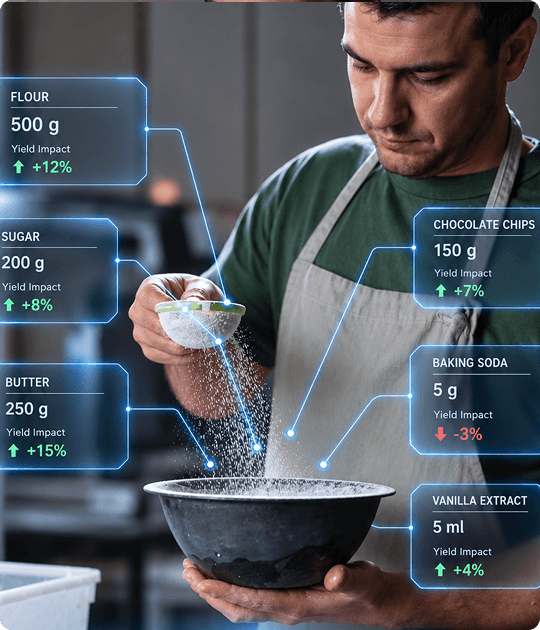
What Is the Best ERP for Food Manufacturers
ERP for food manufacturers earns its keep when it mirrors how product is really made. A bakery on fixed recipes and a cheese or ingredients processor with variable yields will land on different answers, and both answers can be right.
Every enquiry for ERP software for the food and beverage industry begins with a fit assessment. It reviews recipes, batch sizes, site count, whether you sell by unit or by weight, and the audits your customers and certification bodies carry out. Food manufacturing ERP software sized beyond that picture adds cost and months, and software sized below it leaves spreadsheets doing the missing work. A food and beverage manufacturing ERP is judged on that fit.
Book Your Free Fit AssessmentHow Dynamics Square Implements ERP for Food Manufacturers: Phase by Phase
Dynamics Square follows Microsoft’s Success by Design framework for food manufacturing ERP implementations in the UK, addressing food safety requirements from the first workshop.
Discover
Dynamics Square reviews your production process from goods receipt to dispatch, documenting how recipes, batches, and date labels are managed.
Initiate
Next, Dynamics Square defines the project scope, selects the right product, and assigns responsibility for recipe and item data.
Implement
Dynamics Square configures batch tracking, expiry dates, and quality checks, then loads and verifies your recipes and item records.
Prepare
At this stage, we train your team, test real production scenarios, and conduct a mock product recall before the system goes live.
Operate
Dynamics Square supports your team through initial audits, new product launches, and recipe changes after the system goes live.
What Dynamics 365 ERP for Food and Beverage Manufacturing Costs in the UK
The UK list prices below are shown in pounds, excluding VAT. Your total cost depends on user types, labelling systems, and scale integrations required.
Dynamics 365 Business Central
It covers the finance ledger, sales, purchasing and stock, plus lot tracking.
It is the tier for the shop floor, bringing production orders, bills of materials, MRP and the Quality Management module.
It gives occasional users read, approval and light update access.
Dynamics 365 Supply Chain Management
It brings process manufacturing with formulas, catch weight items and quality orders.
It adds deeper analytics and financial planning on top of Standard.
A food or drink producer with one site needs a Business Central implementation covering its core operations. A multi-site Supply Chain Management project involves recipe migration and traceability setup across facilities, increasing the project scope.
Get a Custom Quote
Why UK Food and Drink Producers Work with Dynamics Square
Dynamics Square begins project scoping on your production floor, reviewing batch tracking, date labelling, allergen handling, and recall procedures. These requirements shape the implementation because they matter to your auditors and customers.
We recommend Business Central if it meets your needs, or Supply Chain Management if your operations require more advanced capabilities. Our recommendation is based on your business needs.
Dynamics Square has done over 60 implementations in manufacturing and with the team of 35+ consultants who are certified on both products, we recommend the best fit for your business.
Besides, Dynamics Square’s association carries on after go-live. We support seasonal peaks, new product lines, recipe revisions and audit preparation as your business grows.
Retailers and consumers buy from food companies they trust, and our job is to help your quality team keep that trust intact.
Speak to a Food ERP SpecialistERP for food and beverage manufacturing is a single database for the whole operation, covering buying, goods-in, recipes, production, quality, stock, dispatch and accounts. Each ingredient lot, production run and delivery is held against shared item numbers, so a question about origin or destination gets answered from one place. Microsoft's version is Dynamics 365, offered as Business Central for smaller and mid-sized producers, with Supply Chain Management covering larger or formula-led ones.
The right ERP depends on your recipes, production needs, and number of sites. Business Central Premium suits manufacturers with established recipes and one or a few locations. Supply Chain Management suits manufacturers with changing formulas, co product outputs, weight-based sales, or multiple production sites. The comparison table above highlights the key differences.
Ingredients, intermediates and finished goods each receive a lot or batch number when they arrive or are produced in Dynamics 365. A production order logs the lots it consumes and opens a new lot for its output, and every later pick, transfer and delivery keeps that reference. Supply Chain Management adds batch attributes, such as a measured ingredient percentage, and can merge lots of one product.
A Business Central recipe takes the form of a production bill of materials, and its versions carry start dates and certification statuses. Supply Chain Management manages the recipe as a formula under change control, where a version must be approved and activated, quantities can track batch size or each ingredient's percentage, and a single formula can produce co-products and by-products. Whether your ratios ever change from batch to batch decides which fits.
Yes, both Business Central and Supply Chain Management help manage expiry dates and product traceability. Business Central records expiry dates for each lot and can block expired stock from being picked when strict expiry controls are enabled. It can also prioritise stock with the earliest expiry date. Supply Chain Management tracks shelf life, best before dates, and expiry periods, while accounting for customer requirements on remaining shelf life during shipment planning. Allergen information can be recorded against items or batches for production and dispatch teams. Label wording and cleaning procedures remain part of your food safety system.
Dispatch Every Order with Its Ingredient Lots on the Record
Equip your team with traceability, date control and quality checks, so any recall stays narrow and audits go smoothly.