
500+
Innovative Implementations
150+
Certified Professionals
14+
Years of Experience
What Dynamics 365 for Packaging Manufacturing Does for Your Business
Dynamics 365 ERP for packaging manufacturing helps businesses turn paper, board, film, resin, foil, and ink into boxes, cartons, flexible packs, labels, and containers. It connects customer orders, purchasing, material tracking, production, quality checks, inventory, shipping, and accounting in one system.
Teams can track material costs, monitor waste, and understand how much each job costs. For example, a press running at 150 metres per minute uses 9,000 metres of material every hour. Even 2% waste means losing 180 metres each hour. Dynamics Square offers Business Central and Supply Chain Management, depending on your production needs.

Business Central suits packaging manufacturers with one or a few production facilities and standard product specifications. It works well for corrugated box makers, carton printers, label manufacturers, and flexible packaging businesses. It helps manage production orders, material requirements, product variations, scheduled customer orders, outsourced work, batch tracking, and quality inspections.

Supply Chain Management suits larger packaging manufacturers with multiple factories, complex customer requirements, or advanced production needs. It helps manage custom product options, large material rolls, warehouse operations, machine maintenance, production schedules, and leftover materials. It also supports businesses that cut large rolls into smaller ones.
Customer approvals, certifications, and audits depend on accurate production records. Dynamics 365 helps maintain material, batch, and production records that support these requirements.
Find the Right Platform for Your PlantWhat UK Rules Ask of a Packaging Manufacturer's Records
UK packaging manufacturers must maintain records to meet legal requirements, support customer audits, and provide evidence about materials and production. Five important areas affect the information they need to record and retain.

Packaging Producer Responsibility
UK packaging rules require eligible businesses to report the packaging they supply, fill, import, or sell under their own brands. Reporting depends on business size and packaging volumes. Records must identify packaging materials, weights, and whether they serve household or commercial use. Packaging manufacturers provide important material and weight information that their customers need for these reports.

Packaging Essential Requirements
UK regulations require packaging to use only the material needed for safety, hygiene, and customer acceptance. The combined concentration of lead, cadmium, mercury, and hexavalent chromium must not exceed 100 parts per million. Manufacturers must retain technical documents showing how their packaging meets these requirements and provide them to Trading Standards when requested.

Plastic Packaging Tax
Plastic Packaging Tax applies to plastic packaging manufactured in or imported into the UK that contains less than 30% recycled plastic, subject to applicable exemptions. Businesses crossing the registration threshold must register with HMRC and report their taxable packaging. Records showing recycled and virgin plastic quantities help manufacturers calculate taxable volumes and prepare accurate returns.

Food Contact Materials and Packaging
Packaging used for food must meet UK food contact material safety and traceability requirements. Manufacturers must maintain records showing where materials came from and where finished products went. Plastic food contact packaging also requires a Declaration of Compliance. Many food and drink customers expect BRCGS Packaging Materials certification and evidence of successful traceability tests.

Environmental Claims
UK consumer protection law allows the Competition and Markets Authority to take action against misleading environmental claims. Statements such as recyclable, biodegradable, or made with recycled content must have reliable evidence behind them. Packaging manufacturers should retain material specifications, supplier information, recycled content records, and production details to support claims made about their products.
Orders and Specifications

Business Central can create supply orders when customer demand is recorded, while its Order-to-Order planning links production directly to that specific customer order for production.

Sales Order Planning lets users create a production order for each sales line or one project order covering the entire sale, connecting orders with production and despatch.

Business Central item variants record differences such as product sizes and print versions, ensuring each purchase, production, and sales transaction identifies the exact version handled.

Supply Chain Management configuration models let salespeople select customer options during quoting or order entry, then create the matching bill of materials and production route.
Materials and Traceability

Packaging materials such as board, film, ink, adhesive, and label stock are recorded as items, with lot numbers assigned when each reel, pallet, or drum arrives.

Production orders record the material lots consumed and assign lot numbers to finished output, linking each completed packaging job to the stock used during manufacturing.

Teams can trace supplier lots forward to finished products and customers, or trace complaints backwards to incoming materials, supporting rapid traceability tests and customer investigations.

Business Central converts quantities between reels, sheets, square metres, and kilograms using units of measure, while Supply Chain Management can track item count and weight together.
Planning, Machines and Tooling

Work centres and machine centres hold operating calendars and available capacity, while production routings record the setup and running time required for each manufacturing operation.

Both products use orders and forecasts to suggest purchases and production; Supply Chain Management adds finite capacity scheduling, detailed sequencing, and a Gantt view of press and cutter workloads.

Work sent to outside suppliers for printing, laminating, foil blocking, or die cutting can be recorded as subcontracted operations within the original production order process.

Presses, dies, and cylinders can be recorded as assets; Supply Chain Management Asset Management schedules maintenance by date or usage, such as impressions, and tracks repair costs.
Waste, Quality and Reporting

Manufacturers can add expected material waste to bills of materials and expected production loss to routing steps, helping plans account for scrap before work begins.

During production, operators record actual scrap in the Business Central output journal, selecting a reason code and operation, while recording good finished quantities separately too.

Business Central's 2026 release wave adds Quality Management for receiving and production inspections, including blocking failed lots; Supply Chain Management offers quality orders and sampling plans.

Power BI and Excel can use shared ERP records to report waste by job, machine, and cause, while providing material weights for packaging producer responsibility reporting.
Business Central or Supply Chain Management for Packaging Manufacturing
Packaging manufacturers have different production needs, and Dynamics Square helps them choose between Business Central and Supply Chain Management based on their products, factory operations, production complexity, and business size.
Choose Business Central if
- You receive repeat orders with standard product specifications and familiar customer requirements.
- Your packaging production takes place at one or a few facilities.
- You need production orders, batch tracking, waste records, and incoming material checks at a moderate cost.
- Customers place regular orders and request scheduled deliveries against agreed quantities.
Choose Supply Chain Management if
- Customers choose product options, and each combination needs its own materials list and production steps.
- You cut large material rolls into smaller rolls or sell leftover material separately.
- You need detailed production scheduling and maintenance tracking based on machine usage.
- Your business operates across several factories, companies, or currencies.
| Aspects | Business Central | Supply Chain Management |
|---|---|---|
| Order handling | Order-driven supply, links from order to production, blanket orders | Configuration models behind quotations and sales orders |
| Production style | Production orders from BOMs and routings (Premium licence) | Discrete and process production with deeper planning tools |
| Material units | Units of measure convert reels, sheets and weights | Catch weight items hold count and weight together |
| Planning | MRP, with calendars set on work and machine centres | Master planning, finite capacity, Gantt-style production board |
| Waste handling | Expected scrap set as percentages on BOM and routing lines; actual scrap coded in output journals | Scrap held on formula and BOM lines; cost divided between co-products and by-products |
| Outsourced steps | Subcontracting through a work centre | Vendor-based subcontracting |
| Dies and equipment | Fixed asset records or a partner maintenance app | Asset Management with plans triggered by counters |
| Quality control | Quality Management that can hold back a lot | Quality orders, sampling plans and non-conformance cases |
| Group structure | One operating site | Several legal entities, sites and currencies |
| Starting licence (UK) | Premium: £84.60/user/month | Standard: £161.50/user/month |
Packaging manufacturers often use separate software for estimating and preparing print jobs. Dynamics 365 manages purchasing, inventory, production, and accounts, while sharing job details with these tools. It can also connect with press controls, weighing machines, and label printers.
Dynamics Square identifies the required connections during planning, helping job, material batch, and weight information move accurately between systems.
Get a Platform Recommendation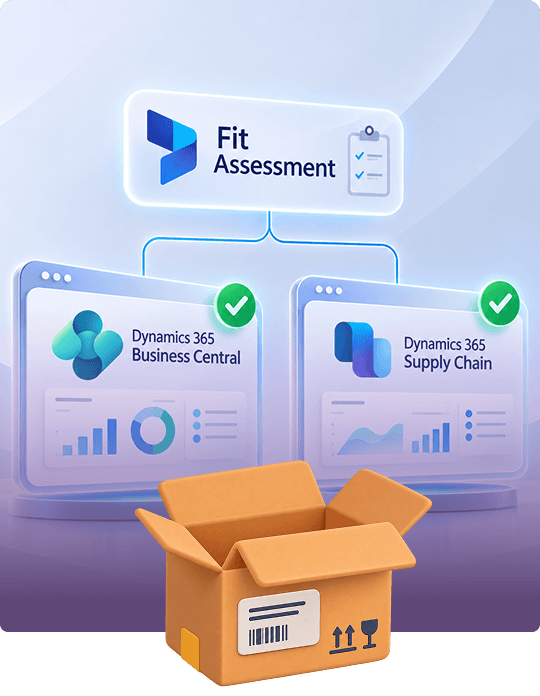
What Is the Best ERP for Packaging Manufacturing?
A corrugated box manufacturer, a flexible packaging converter, and a drinks label printer follow different production processes. Each needs an ERP system that matches how its factory operates.
Dynamics Square first reviews your order patterns, product changes, factory locations, outsourced work, and customer audit requirements. This helps us recommend the right ERP without adding unnecessary costs or leaving important tasks, such as job costing, waste tracking, and tooling records, dependent on spreadsheets.
Book Your Free Fit AssessmentPackaging ERP Implementation in the UK: How Dynamics Square Does It
Dynamics Square follows Microsoft's Success by Design approach to implement Dynamics 365 for packaging manufacturers. We first understand how your business handles materials, production, waste, and job costs. This helps us configure the ERP around your factory operations and reporting needs.
Discover
Dynamics Square visits your goods-in area, production floor, converting lines, and despatch bay. We study how your team manages materials, machines, tooling, and leftover stock.
Initiate
Dynamics Square confirms the project scope, selects the right ERP, and agrees on responsibilities with your team. We also assign clear ownership of product specifications, material records, and tooling details.
Implement
Dynamics Square configures products, material batches, production steps, waste records, and job costing. We then transfer customer, supplier, and open order data, checking the figures against your existing records.
Prepare
Dynamics Square trains your employees and tests the system using actual production jobs. Teams practise tracking materials from goods-in through manufacturing, finished goods, and final delivery.
Operate
Dynamics Square continues supporting your business after launch. We help manage new products, material changes, production requirements, and customer audits as your operations grow.
Dynamics 365 ERP for Packaging Manufacturing Pricing in the UK
Current UK list prices are shown in pounds before VAT. Estimating, weighing or label printing products from partners, and the balance of full and occasional users, change the final total.
Dynamics 365 Business Central
It comes with finance, sales, purchasing and inventory including lot tracking.
Premium carries production orders, BOMs, routings and MRP, along with Quality Management.
It is for people who look up data, approve requests or edit lightly.
Dynamics 365 Supply Chain Management
It covers quality orders, asset management, finite scheduling and option-based configuration.
It comes with Standard's features plus Copilot Credits and planning tools for demand, capacity and storage.
ERP implementation is priced separately from software licences. A single-factory Business Central project usually requires less work, while a multi-site Supply Chain Management project involves more data, specifications, and tooling records to transfer. Dynamics Square reviews your requirements and provides a detailed project quotation.
Get a Custom Quote
Why UK Packaging Manufacturers Work with Us
Our experience includes more than 60 manufacturing ERP implementations, giving us practical knowledge of production processes, material tracking, waste control, and job costing.
Our team includes 35+ manufacturing and supply chain consultants who understand factory operations and the ERP requirements of packaging businesses.
We study your production processes before recommending Business Central or Supply Chain Management. You receive a clear explanation of which system fits your factory and why.
Our consultants hold certifications in both Business Central and Supply Chain Management. This helps us recommend, configure, and implement the right system for your operations.
We continue supporting your business after launch as you introduce new products, change materials, update tooling, and prepare for customer audits.
We help connect material, production, and inventory records so your teams can provide accurate information during customer audits and traceability checks.
Talk to a Packaging ERP SpecialistPackaging manufacturing ERP is software that connects customer orders, purchasing, production, inventory, quality checks, shipping, and accounting in one system. It helps manufacturers track materials such as board, film, and ink, monitor production costs, record waste, and trace finished goods to customers. Business Central suits standard packaging operations, while Supply Chain Management supports larger businesses with more complex production needs.
Yes, Dynamics 365 supports manufacturers of corrugated boxes, cartons, flexible packaging, labels, and rigid containers. Business Central manages production orders, material requirements, inventory, batch tracking, and quality checks. Supply Chain Management adds advanced scheduling, custom product configurations, warehouse management, and machine maintenance. The right choice depends on your factory size, production processes, and customer requirements.
Yes, Dynamics 365 manages custom packaging orders from customer requirements through production and delivery. Business Central links production orders to customer demand and supports product variations, such as different sizes and print versions. Supply Chain Management handles more complex options by creating the required material lists and production steps for each selected specification. Both products help track materials, machine time, and production costs.
Yes, Dynamics 365 assigns batch numbers to incoming materials and records which batches each production job uses. This helps trace materials from suppliers to finished products and customers. Teams can also record expected and actual waste during production. Reports show scrap by job, machine, and reason, helping manufacturers identify material losses and control production costs.
Yes, Dynamics 365 helps plan production using machine availability, working hours, and manufacturing steps. Supply Chain Management adds advanced scheduling to manage limited machine capacity and changing production priorities. For quality control, Business Central supports inspections and can block materials that fail checks. Supply Chain Management provides additional quality orders and sampling plans for more detailed testing requirements.