
QuickBooks to Microsoft Dynamics 365 Business Central for Professional Services
How a Growing Forensic Accounting and Architecture Firm Built a Scalable, Project-Driven ERP Foundation with Microsoft Dynamics 365 Business Central
 Forensx
A Crux of the Case Story
Forensx, a professional services firm specialising in forensic accounting and architecture, was preparing for rapid growth into new regions. Its finances ran on QuickBooks and spreadsheets, timesheets were tracked by hand and invoicing was slow and error-prone. Dynamics Square implemented cloud-based Microsoft Dynamics 365 Business Central, giving the firm a structured, scalable framework for project finances, timesheets and invoicing before growth made the change harder.
Business Overview
Forensx delivers project-based services in forensic accounting and architecture. Its work depends on accurate financial tracking, structured resource management and clear visibility of every project.
When Dynamics Square became involved, the business was at an early stage but changing fast. It planned to grow from around 15 people to between 50 and 100 by the end of 2026, open a new office in Dubai and expand further in the US and Europe.
The firm operates through a group holding company and several operating entities, including international operations. The holding company does not trade actively, but it plays an important role in financial transactions and governance.
The business already used Microsoft 365 and wanted a cloud-based system that would fit naturally into that environment. Project management ran in Primavera.
Core financial operations, however, still ran on QuickBooks, which was showing clear limits as the business grew in scale and complexity.

What are The
Business Challenges
Despite having foundational systems in place, the firm faced operational challenges that limited efficiency and visibility.
These challenges created friction and made it difficult for the business to scale efficiently.
What the Business Needed
To support its growth, the firm needed a system that could unify operations while staying simple and easy to use.
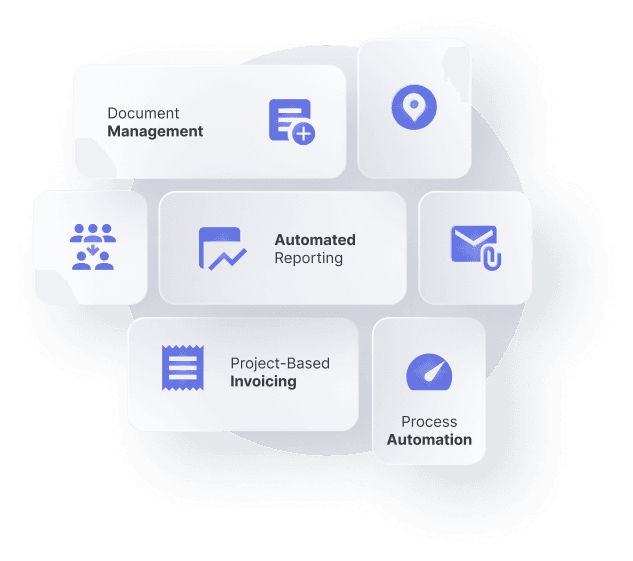
- A cloud-based ERP to replace QuickBooks.
- Integrated timesheet management with approval workflows.
- Invoicing linked directly to project and timesheet data.
- Clear visibility of project budgets, costs and profitability.
- Accurate WIP tracking and financial controls.
- System-driven reporting to reduce dependence on spreadsheets.
- Central document management integrated with SharePoint.
- Client data connected across finance and operational workflows.
- An intuitive system that removes manual workarounds.
The focus was clear: simplify operations while enabling control and scale.
Business Objectives
The leadership team set clear objectives for the transformation:
Implement a scalable ERP to support growth across regions.
Improve financial accuracy and centralise financial management.
Introduce structured timesheet capture and approval.
Automate invoicing to reduce manual effort and errors.
Improve visibility of project performance, including budgets and profitability.
Strengthen WIP tracking and financial governance.
Provide real-time, role-based reporting.
Establish a single source of truth for documents and client data.
Improve usability to drive faster adoption.
Solutions Proposed by Dynamics Square
Dynamics Square recommended Microsoft Dynamics 365 Business Central (SaaS) to support project-based work and expansion across several entities, using the Jobs module as the backbone for project finance.
Core ERP Implementation
- Deployed Business Central in the cloud.
- Set up multi-company and multi-currency operations for the holding company and operating entities.
- Integrated Business Central with Microsoft 365.
Jobs Module for Project Management
- Set up projects and project tasks, project planning lines and project WIP tracking.
- Configured project, general ledger and recurring journals, plus project expense booking.
- Enabled project sales invoicing, timesheet booking and approval, and resource management.
- Delivered project reports: project analysis, planning lines, transaction details, actual versus budget, WIP to G/L, and projects per customer.
Timesheet, Invoicing and WIP Integration
- Built end-to-end timesheet-to-invoice workflows.
- Introduced structured timesheet capture with approvals.
- Configured WIP accounting to improve financial tracking and control.
Process Enhancements and Customisations
- Redesigned the invoice layout to match the firm’s branding and client communication.
- Developed project-wise resource utilisation reports for better planning.
- Added a validation that restricts invoice creation against defined WIP thresholds.
Reporting and Document Management
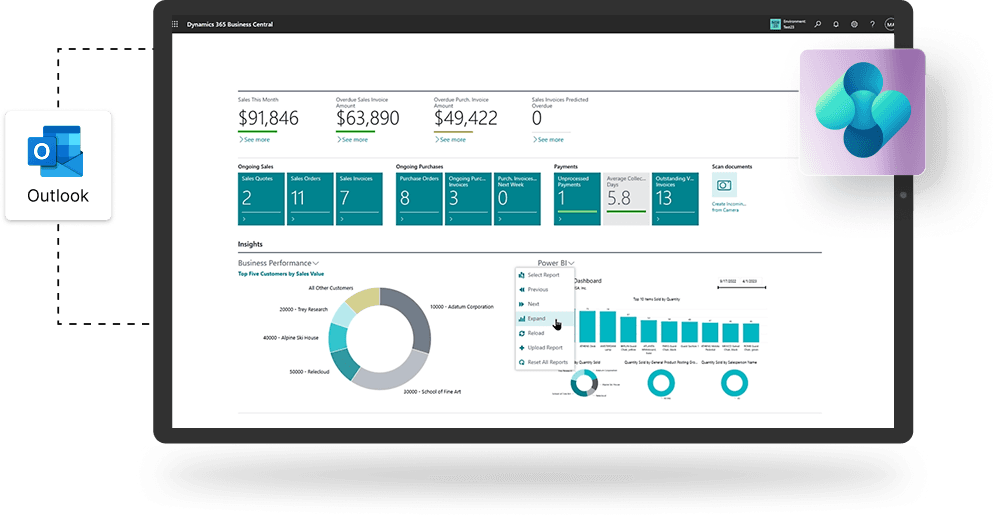
- Delivered real-time, role-based reporting to reduce dependence on spreadsheets.
- Gave visibility of project budgets, costs and profitability.
- Integrated SharePoint so project documents are linked directly from Business Central, creating one source of truth.
CRM and Data Integration
- Enabled basic CRM capabilities within Business Central.
- Integrated Outlook to track client communication.
- Created a unified view of client data across finance and project operations.
Results and Impact: What This Transformation Means
The implementation moves Forensx from fragmented, manual processes to a structured, integrated way of working.
Centralised financial management with better accuracy and control.
End-to-end visibility of project budgets, costs and profitability.
Controlled timesheet processes with approval workflows.
Automated invoicing that cuts manual effort and shortens billing cycles.
Stronger WIP tracking and financial governance.
Real-time reporting in place of spreadsheets.
A single source of truth for project documents.
Client data connected across finance and project work.
An easier system that teams adopt faster.
Why This Case Matters and Future Prospects

Consult To Reveal Best Approach
Connect with us to facilitate your system to drive a parallel approach in the market you deal with. We help enterprises to implement their unique needs.