
Performing financial consolidation in Dynamics 365 Finance enables the parent organisation to maintain better financial visibility across all subsidiary organisations. Regardless of the currencies used by different entities, businesses can consolidate financial data, translate balances and generate consolidated financial statements to support informed decision-making. Before exploring the core benefits and capabilities of financial consolidation in D365 Finance, let's understand the basic concepts.
What is Financial Consolidation?
We know that streamlining and managing financial transactions for a business is a complicated process that must be executed with precision. One such process is financial consolidation, where large organisations combine the financial statements of multiple entities or subsidiaries to create a centralised financial report.
Table of Contents
Such data is primarily generated for senior management and stakeholders who want a 360-degree financial view across all entities and need to control the business based on accurate financial information.
Financial consolidation reporting empowers investors and management teams to assess the overall financial health of a group rather than analysing the financial reports of each company separately. Most businesses manage financial operations independently at the entity level and then consolidate the results to gain a holistic financial view of their multi-location operations.
Some organisations still perform this process manually using spreadsheets. Although spreadsheets can be inexpensive and familiar to finance teams, manual consolidation can introduce calculation errors, duplicate data, inconsistent reporting and difficulties in maintaining an audit trail as the business grows.
This leads businesses to adopt advanced financial management solutions that simplify complex financial processes while improving financial accuracy and visibility.
Microsoft Dynamics 365 Finance supports financial consolidation by combining financial balances from multiple subsidiaries into a consolidated legal entity. Businesses can use it to prepare consolidated balance sheets, income statements and other financial reports while managing currency translation, account mapping and intercompany eliminations. The solution also supports different consolidation requirements, including subsidiaries operating with different currencies and charts of accounts.
Financial Consolidation in Dynamics 365 Finance
Dynamics 365 Finance is a powerful solution capable of managing complex financial operations of businesses. It can consolidate financial data from different entities into a unified financial view, including subsidiaries that operate with different accounting currencies, charts of accounts and fiscal calendars.
The financial consolidation process starts by preparing the relevant subsidiary legal entities and creating a separate legal entity to hold the consolidated financial results. Financial balances from subsidiary companies are then transferred or consolidated into the parent reporting structure using the required currency translation settings.
However, you cannot post daily journals directly in a consolidation company. You can post daily journals in an elimination company, which is used to process adjustments and eliminate intercompany transactions. Therefore, businesses may need a separate elimination company depending on their consolidation requirements.
Because the main purpose of a consolidation company is to provide a consolidated view of the group's financial information, direct posting of daily journals is restricted. This helps maintain the integrity of consolidated balances. An elimination company, on the other hand, allows finance teams to record the adjustments required to eliminate intercompany transactions and prepare accurate group financial statements.
Methods of Financial Consolidation in Dynamics 365 Finance
Dynamics 365 Finance offers different approaches to financial consolidation. The right method depends on the reporting requirements, organisational structure and level of financial detail needed by the business.
1. Consolidate Online
Consolidate Online combines financial balances from multiple legal entities and stores the consolidated results in a separate consolidation legal entity. Businesses can configure account mapping, currency translation and elimination settings as part of the consolidation process. The process can be run again whenever updated source balances need to be included.
2. Financial Reporting
Financial Reporting allows businesses to consolidate financial information when generating reports. It supports multi-level consolidation, different reporting currencies, financial dimensions and drill-down into underlying transactions. Unlike Consolidate Online, it does not require the same process of creating consolidated balances in a separate legal entity for every report.
Businesses can also use both methods together, depending on their financial reporting and audit requirements.
Performing Financial Consolidation in Dynamics 365 Finance and Operations
Performing financial consolidation in Dynamics 365 Finance and Operations requires the correct configuration of legal entities, ledgers, exchange rates and consolidation settings. Before running the consolidation, you need to complete the following prerequisites.
Go to Organization administration > Organizations > Legal entities and create a new legal entity for consolidation.
Select the Use for financial consolidation process option when configuring the new legal entity.
Configure the consolidation company's ledger, including its chart of accounts, fiscal calendar, accounting currency and reporting currency, where applicable.
Prepare the subsidiary legal entities and verify their financial data, account mappings and currency settings.
If required, create a separate elimination legal entity to manage intercompany elimination transactions.
Set Up Automatic Transactions
Go to General ledger > Setup > Posting > Accounts for automatic transactions.
Review the posting types required for consolidation differences.
Configure the appropriate balance sheet account for consolidation differences or profit and loss account for consolidation differences, depending on the relationship between the parent and subsidiary entities.
For foreign subsidiaries, select the appropriate accounts for currency translation adjustments and unrealised gains or losses based on the consolidation requirements.
The correct posting account depends on whether the subsidiary is financially and operationally interdependent with the parent organisation or operates independently. Therefore, the configuration should be reviewed according to the group's accounting policy.
Setting Up Ledger Balances
Go to General ledger > Ledger setup and review the ledger configuration for the consolidation company.
Verify the chart of accounts, fiscal calendar, accounting currency and default exchange rate type.
Review the main accounts and define consolidation accounts where the parent and subsidiary companies use different charts of accounts.
Configure the relevant accounts for automatic consolidation differences and currency translation adjustments.
When subsidiaries use different charts of accounts, you can map their main accounts to the appropriate consolidation accounts. Dynamics 365 Finance supports mapping through default consolidation accounts or consolidation account groups.
Setting Up Exchange Rates
Go to General ledger > Currencies > Currency exchange rates.
Set up the relevant currency pairs and exchange rates for the subsidiary companies.
Configure the exchange rate types required for the consolidation process.
Define the appropriate exchange rate application method in the consolidation settings.
Dynamics 365 Finance supports different currency translation approaches depending on the account type and consolidation requirements. For example, a consolidation-date rate can be used for balance sheet accounts, while transaction-date rates can be appropriate for certain historical-value accounts. User-defined rates can also be configured where required.
Till now, we have covered the main configuration steps required to prepare for financial consolidation. The next step is to configure the consolidation template and run the process.
Configure Consolidation Templates
Consolidation templates help businesses save and reuse their consolidation settings instead of configuring the same information every time. They can include the source legal entities, account ranges, currency translation settings and budget information required for consolidation.
Open the consolidation template configuration in the General ledger consolidation area.
Select the subsidiary legal entities that need to be included.
Configure the main account ranges and consolidation account mappings.
Define the currency translation settings, including the exchange rate type and applicable rate date.
Choose whether actual and budget amounts should be included in the consolidation.
Save the template for use when running the consolidation process.
Perform Online Consolidation
The process of performing online consolidation is more structured than manually combining financial information in spreadsheets. Once the required legal entities, accounts, exchange rates and consolidation templates are configured, follow these steps:
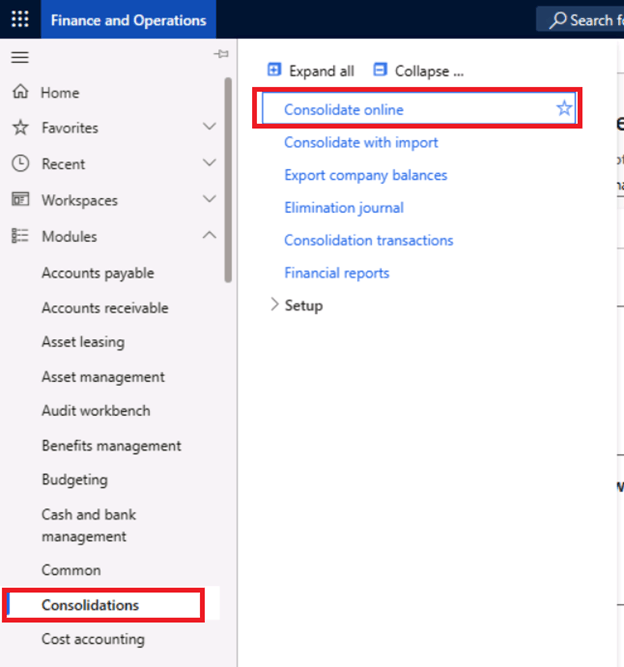
Open the Consolidate Online page from the Consolidations menu.
Select the option to perform consolidation and specify the financial period using the From and To dates.
Select the appropriate consolidation template containing the required legal entities and configuration settings.
Review the account ranges, currency translation methods and consolidation account mappings.
Choose whether to include actual amounts and budget amounts, according to your reporting requirements.
Review the selected settings and run the consolidation process.
After processing, review the consolidated balances in the consolidation company or generate the relevant financial reports.
Businesses can run the consolidation process again when source financial data changes. It is also important to review the consolidated balances and investigate any differences before finalising group financial statements.
Intercompany Eliminations in Dynamics 365 Finance
Intercompany eliminations are an important part of financial consolidation, particularly for organisations with multiple subsidiaries. When companies within the same group trade with each other, their transactions can appear in the financial statements of both entities. These balances must be eliminated during group consolidation to avoid overstating revenue, expenses, assets or liabilities.
Dynamics 365 Finance supports elimination rules and elimination journals to help manage these adjustments. Businesses can configure elimination rules for relevant intercompany accounts and process elimination transactions in a consolidation or separate elimination legal entity, depending on their requirements.
Common intercompany transactions that may require elimination include:
Intercompany sales and purchase transactions.
Receivables and payables between group companies.
Intercompany revenue and expenses.
Loans and other balances between subsidiaries.
Unrealised profit included in inventory or other group assets.
Finance teams should reconcile intercompany balances before processing eliminations to ensure that both sides of the transactions match.
Managing Foreign Currency Translation and Minority Interest
Businesses operating across multiple countries often maintain financial records in different accounting currencies. During consolidation, these balances need to be translated into the reporting currency of the parent organisation.
Dynamics 365 Finance supports currency translation using configured exchange rate types and methods. Financial Reporting also provides currency translation methods such as current, average and weighted average rates, depending on the account and reporting requirements.
For example, balance sheet accounts may use the current exchange rate, while income statement accounts may use an average or weighted average rate. The appropriate method should follow the organisation's accounting policies and applicable reporting standards.
Another important consideration is minority interest. When a parent organisation does not own 100% of a subsidiary, the consolidated financial statements may need to reflect the ownership percentage and the interests of other shareholders. Financial Reporting supports minority interest through reporting structures and roll-up percentages. With Consolidate Online, minority interest calculations and entries require manual handling.
How Can Dynamics Square Help You Streamline Financial Consolidation?
Performing accurate and efficient financial consolidation is a critical process, and it leaves little room for human errors or uncertainty. Organisations need reliable financial data, consistent reporting and accurate currency translation to maintain better control over their group finances.
If you want to improve your financial consolidation process, Dynamics Square can help. With 14+ years of experience and a team of expert Dynamics 365 consultants, we help businesses configure financial management processes, streamline intercompany operations and improve reporting across multiple legal entities.
Whether you need support with consolidation setup, currency translation, intercompany eliminations or a wider Dynamics 365 Finance implementation, our specialists can help you identify an approach that meets your business requirements.
To discuss your financial management requirements, email us at info@dynamicssquare.co.uk or call 0203 769 7689 for expert support.
Frequently Asked Questions
Financial consolidation in Dynamics 365 Finance combines financial balances from multiple legal entities into a consolidated financial view. It helps organisations prepare group financial statements, manage currency translation and handle intercompany eliminations.
Consolidate Online transfers financial balances into a separate consolidation legal entity. Financial Reporting consolidates financial information when reports are generated and supports multi-level reporting, currency translation and transaction drill-down.
Yes. Dynamics 365 Finance supports multi-currency consolidation through configured exchange rates and currency translation methods. Businesses can translate subsidiary balances into the accounting currency of the consolidation company.
Dynamics 365 Finance supports elimination rules and elimination journals to remove qualifying intercompany balances and transactions from consolidated financial statements. Businesses should reconcile intercompany accounts before processing eliminations.
Yes. Financial Reporting supports minority interest through reporting structures and ownership percentages. In Consolidate Online, minority interest calculations and related entries require manual handling.