Technology is changing faster than most businesses can adapt. Artificial intelligence, automation, cloud platforms, connected devices and advanced analytics are moving from emerging technologies into practical business tools.
For organisations planning their technology strategy in 2026, the focus is no longer simply on adopting the latest technology. Businesses need to understand which technologies can improve productivity, strengthen decision-making, reduce operational costs and create a more connected digital environment.
Table of Contents
From agentic AI and AI-powered automation to Microsoft Fabric, Physical AI, cybersecurity and edge computing, several technology trends are shaping how businesses operate and invest in technology.
In this guide, we explore 10 technology trends businesses should understand in 2026 and what they could mean for organisations planning their digital transformation strategy.
10 Technology Trends Businesses Should Watch in 2026
1. Agentic AI and Multi-Agent Systems
Artificial intelligence is moving beyond systems that simply answer questions or generate content. One of the major developments in 2026 is the growing use of AI agents that can understand objectives, plan tasks and perform actions across business workflows.
Agentic AI can be used to support processes such as customer service, finance, sales, procurement and internal operations. Instead of requiring employees to complete every step manually, AI agents can assist with multi-step workflows while people retain oversight of important decisions.
Multi-agent systems take this concept further by allowing specialised AI agents to work together on different parts of a process.
For businesses, this creates opportunities to automate workflows that previously required multiple manual steps, applications and approvals.
Microsoft is also expanding AI capabilities across its business applications and Copilot ecosystem. Businesses exploring this area can learn more about Copilot Agents and how AI agents can support business processes.
2. Generative AI and Domain-Specific AI
Generative AI has moved beyond general-purpose content creation. Businesses are increasingly interested in AI systems that understand a particular industry, function, process or business dataset.
Domain-specific AI can provide more relevant outputs because it is designed around a defined business context. Examples can include AI for finance, manufacturing, supply chain, customer service or sales.
For businesses, the value of generative AI increasingly depends on the quality of the data, processes and governance behind it.
AI connected to business applications can help employees summarise information, generate content, analyse data, identify patterns and support routine decisions.
Microsoft Dynamics 365 already incorporates AI and Copilot capabilities across several business applications. Businesses can explore Microsoft Dynamics 365 Copilot to understand how AI is being applied within the Microsoft business application ecosystem.
3. AI-Native Software Development
AI is also changing how software is designed, developed and maintained. Developers can use AI-assisted tools to generate code, identify potential issues, create documentation, test applications and accelerate repetitive development tasks.
AI-native development goes beyond using an AI tool occasionally. It involves designing applications and development workflows with AI capabilities as an integral part of the technology architecture.
For businesses, this can potentially shorten development cycles and make it easier to build or customise applications around specific operational requirements.
However, organisations still need appropriate security, testing, governance and human review when AI is used to develop production software.
4. AI-Powered Business Automation
Business automation is moving from traditional rule-based workflows towards intelligent automation that combines AI, workflow engines, business applications and data.
Traditional Robotic Process Automation (RPA) remains useful for repetitive, rule-based tasks. However, businesses can now combine automation with AI to handle processes that involve documents, natural-language information, recommendations and more complex workflows.
Common examples include:
Invoice processing and approval
Customer enquiry handling
Document classification
Data extraction
Employee onboarding workflows
Finance approvals
Customer follow-ups
Business reporting workflows
Microsoft Power Automate can help businesses build automated workflows across applications and services. Organisations can also combine automation with Dynamics 365, Power Platform and AI capabilities depending on their requirements.
Businesses interested in workflow automation can explore Microsoft Power Automate and its role in automating business processes.
5. AI-Powered Analytics and Business Intelligence
Business Intelligence remains important, but the way businesses use analytics is changing. Modern organisations increasingly expect data platforms to provide not only reports but also interactive dashboards, real-time insights, predictive analysis and AI-assisted decision support.
Microsoft Power BI continues to provide businesses with tools for data visualisation, dashboards and business analytics.
AI can add another layer by helping users identify patterns, understand trends and interact with business data using natural language.
For finance, sales, operations and management teams, this can reduce the time required to move from raw data to actionable insight.
Businesses can explore Microsoft Power BI to understand how data visualisation and analytics can support business decision-making.
6. Microsoft Fabric and Unified Data Platforms
As businesses collect data from ERP, CRM, websites, applications, IoT devices and other systems, managing that information across disconnected platforms becomes increasingly difficult.
This is creating greater demand for unified data and analytics platforms.
Microsoft Fabric brings together data engineering, data science, data warehousing, real-time intelligence and Power BI within a unified analytics environment.
For businesses, a unified data platform can help create a more consistent foundation for analytics and AI by bringing relevant data together rather than maintaining separate data environments for every use case.
Microsoft Fabric can be particularly relevant for organisations that already use Microsoft technologies such as Power BI, Azure and Dynamics 365.
Learn more about Microsoft Fabric and AI-powered data analytics.
7. Physical AI, Robotics and Intelligent Manufacturing
AI is increasingly moving from software environments into the physical world.
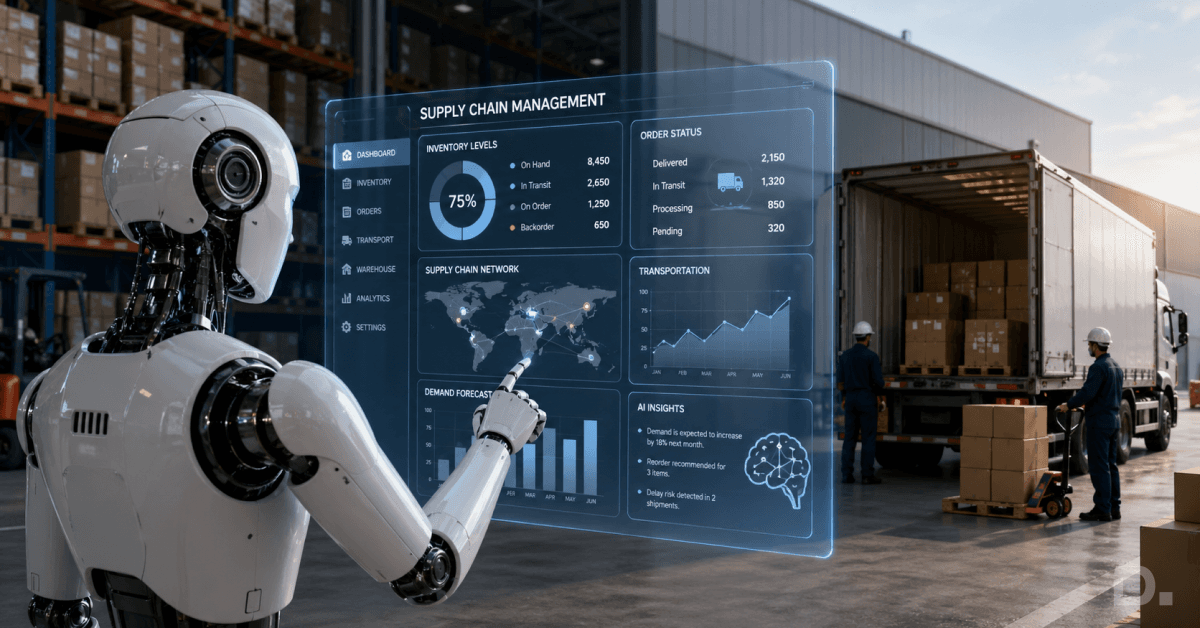
Physical AI refers to AI systems embedded into machines, robots, vehicles and other physical systems that can perceive their environment and respond to real-world conditions.
This has significant potential for manufacturing and industrial organisations.
Examples include:
Intelligent robotics
Automated production processes
Computer vision for quality inspection
Autonomous warehouse systems
Predictive maintenance
AI-assisted production planning
Intelligent industrial equipment
For manufacturers, the convergence of AI, IoT, robotics and connected business systems can create opportunities to improve production visibility and operational efficiency.
Businesses evaluating intelligent manufacturing technologies should also consider how operational data connects with their ERP, supply chain and analytics platforms.
8. Edge Computing and Industrial IoT
Cloud computing remains central to modern technology architectures, but not every workload needs to send all data to a central cloud environment before processing can take place.
Edge computing allows data to be processed closer to where it is generated. This can be useful when businesses need fast responses, low latency or continued operation in environments with limited connectivity.
Edge computing is particularly relevant to manufacturing, logistics, healthcare and other environments where connected devices continuously generate operational data.
When combined with the Internet of Things (IoT), edge computing can support use cases such as:
Machine monitoring
Equipment performance analysis
Predictive maintenance
Industrial monitoring
Real-time alerts
Connected warehouse operations
Microsoft Azure provides cloud and IoT technologies that can be used to connect devices, process data and build intelligent applications. Businesses can explore Microsoft Azure and Azure IoT for more information.
9. AI-Powered Cybersecurity, Security and Digital Trust
As businesses increase their use of cloud services, AI, connected applications and digital workflows, cybersecurity becomes increasingly important.
Traditional security controls remain necessary, but organisations are also using AI and automation to detect unusual behaviour, identify potential threats and respond to security events more quickly.
Businesses also need to consider the security implications of AI itself. AI systems can introduce risks involving data access, privacy, model behaviour, identity and unauthorised use.
Digital trust therefore involves more than protecting the network. Organisations need appropriate controls around:
Identity and access management
Data protection
AI governance
Application security
Threat detection
Data provenance
Regulatory compliance
For organisations adopting AI and cloud technologies, security should be considered during technology planning rather than treated as a separate activity after implementation.
10. Quantum Computing and Next-Generation Computing
Quantum computing remains an emerging technology rather than a mainstream replacement for conventional business computing. However, continued development means businesses should understand where quantum technologies could eventually have an impact.
Quantum computing uses quantum-mechanical principles to approach certain computational problems differently from traditional computers.
Potential long-term applications include areas such as:
Complex optimisation
Financial modelling
Drug and materials research
Advanced simulation
Cryptography and security research
For most businesses, the immediate priority is not replacing existing infrastructure with quantum computers. Instead, organisations should monitor developments and consider how future advances could affect their industry, security strategy and technology roadmap.
What Do These Technology Trends Mean for Businesses?
The individual technologies are important, but the bigger change is how they are beginning to work together.
For example, an organisation could combine:
Dynamics 365 for business processes and operational data
Microsoft Fabric for data and analytics
Power BI for dashboards and business intelligence
Power Automate for workflow automation
Copilot and AI agents for intelligent assistance and task execution
Azure for cloud infrastructure and AI capabilities
IoT and edge technologies for connected operational environments
The result can be a more connected technology environment where business data, automation, analytics and AI work together rather than operating as separate tools.
How Should Businesses Prepare for Technology Changes in 2026?
Businesses do not need to adopt every emerging technology. A more practical approach is to identify the business problems that technology needs to solve and then select the appropriate tools.
1. Identify High-Value Business Problems
Start with areas where the organisation is losing time, money or visibility. Examples include manual reporting, repetitive administration, fragmented data, inefficient customer service or limited operational visibility.
2. Review Your Existing Technology Stack
Before purchasing another application, review the systems already in use. Your existing ERP, CRM, Microsoft 365 environment and cloud platform may already provide capabilities that can be extended.
3. Improve Data Quality
AI and analytics depend heavily on reliable data. Organisations should address duplicate records, inconsistent definitions, disconnected systems and data governance before scaling AI-driven initiatives.
4. Build Security and Governance Into the Strategy
AI, automation and cloud adoption should be accompanied by appropriate security, access controls, governance and compliance processes.
5. Start With Practical Use Cases
Rather than launching a large technology programme without a defined outcome, businesses can start with a measurable use case such as automated invoice processing, management dashboards, customer service assistance or predictive maintenance.
6. Plan for Integration
Technology investments deliver more value when systems can share relevant data. Integration should therefore be considered during technology planning rather than added as an afterthought.
How Dynamics 365 Fits Into the 2026 Technology Landscape
Microsoft Dynamics 365 can form part of a wider business technology ecosystem rather than operating as an isolated ERP or CRM platform.
Depending on the organisation's requirements, Dynamics 365 can connect with Microsoft technologies including Power Platform, Power BI, Microsoft Fabric, Azure and Copilot.
This allows businesses to combine core business applications with analytics, automation, AI and cloud capabilities.
For example, a business could use Dynamics 365 to manage core processes, Power BI to visualise performance, Power Automate to automate workflows, Microsoft Fabric to bring data together and AI capabilities to assist users with specific tasks.
How Dynamics Square Can Help With Technology Modernisation
Technology adoption works best when it starts with a clear business requirement. Businesses do not necessarily need to implement every emerging technology mentioned in this guide.
Dynamics Square can help organisations assess their existing Microsoft technology environment and identify where Dynamics 365, Power Platform, Power BI, Microsoft Fabric, Azure or AI capabilities may fit into their digital transformation strategy.
Our services can support areas such as ERP implementation, CRM implementation, business intelligence, workflow automation, Microsoft cloud technologies and AI-enabled business solutions.
If your organisation is reviewing its technology roadmap for 2026-27, contact Dynamics Square UK to discuss your requirements and explore relevant Microsoft technology options.
Final Thoughts
Technology trends in 2026 are increasingly centred around AI, connected data, automation, intelligent applications and secure cloud infrastructure.
Agentic AI, domain-specific AI, Microsoft Fabric, AI-powered analytics, Physical AI, edge computing and intelligent automation are changing how businesses think about technology investment.
However, adopting a technology simply because it is trending does not guarantee business value. The right approach is to connect each technology investment to a clear business outcome, reliable data, appropriate governance and a practical implementation plan.
For organisations already using Microsoft technologies, the opportunity may be less about replacing everything and more about connecting and extending the technology stack they already have.
Frequently Asked Questions
Major technology trends in 2026 include agentic AI, generative and domain-specific AI, AI-powered automation, AI-native software development, Microsoft Fabric and unified data platforms, Physical AI, edge computing, AI cybersecurity and next-generation computing.
AI can help businesses automate tasks, analyse information, support employees, improve customer interactions and work with large volumes of business data. The business value depends on the quality of the use case, data, governance and implementation.
Agentic AI refers to AI systems that can work towards defined objectives, plan tasks and perform actions across workflows with varying levels of human oversight. Multi-agent systems can involve multiple specialised agents working together.
Microsoft Fabric provides a unified analytics environment that brings together data engineering, data science, data warehousing, real-time intelligence and Power BI capabilities. It can help organisations create a more connected foundation for analytics and AI.
AI and automation can reduce manual work across processes such as document processing, approvals, reporting, customer service and finance. Businesses can combine AI with workflow automation to handle more complex processes than traditional rule-based automation alone.
Physical AI refers to AI systems that operate in or interact with the physical world through machines, robots, vehicles and intelligent equipment. It can have applications in manufacturing, logistics, warehousing and other industrial environments.
No. Businesses should evaluate technologies based on their specific operational challenges, technology environment, data readiness, security requirements and expected business outcomes.
Businesses can start by identifying practical use cases, improving data quality, reviewing existing systems, establishing security and governance controls and defining measurable outcomes before scaling AI initiatives.